COVID-19

2.History about covid 19
The novel human coronavirus disease COVID-19 has become the fifth documented pandemic since the 1918 flu pandemic. COVID-19 was first reported in Wuhan, China, and subsequently spread worldwide. The coronavirus was officially named severe acute respiratory syndrome coronavirus 2 (SARS-CoV-2) by the International Committee on Taxonomy of Viruses based on phylogenetic analysis. SARS-CoV-2 is believed to be a spillover of an animal coronavirus and later adapted the ability of human-to-human transmission. Because the virus is highly contagious, it rapidly spreads and continuously evolves in the human population. In this review article, we discuss the basic properties, potential origin, and evolution of the novel human coronavirus. These factors may be critical for studies of pathogenicity, antiviral designs, and vaccine development against the virus
3.How covid 19 spreads
?This virus probably originally emerged from an animal source, but now is able to spread from person-to-person. Coronaviruses generally spread by respiratory droplets generated when a sick person coughs or sneezes. Coronaviruses may survive on surfaces that have been contaminated with respiratory secretions. (For example, a sick person coughs on their hand and then touches a doorknob.) Thus, contaminated surfaces may be another, less common, route of transmission. It should be noted that.
4.What is the early symptoms?.
1. fever.
2. chills.
3. repeated shaking with chills.
4. muscle pain.
5. headache.
6. sore throat.
7. new loss of taste or smell.
5.what is the effect?
COVID-19 (Coronavirus) has affected day to day life and is slowing down the global economy. This pandemic has affected thousands of peoples, who are either sick or are being killed due to the spread of this disease. The most common symptoms of this viral infection are fever, cold, cough, bone pain and breathing problems, and ultimately leading to pneumonia. This, being a new viral disease affecting humans for the first time, vaccines are not yet available. Thus, the emphasis is on taking extensive precautions such as extensive hygiene protocol (e.g., regularly washing of hands, avoidance of face to face interaction etc.), social distancing, and wearing of masks, and so on. This virus is spreading exponentially region wise. Countries are banning gatherings of people to the spread and break the exponential curve. Many countries are locking their population and enforcing strict quarantine to control the spread of the havoc of this highly communicable disease
6.How to prevent.
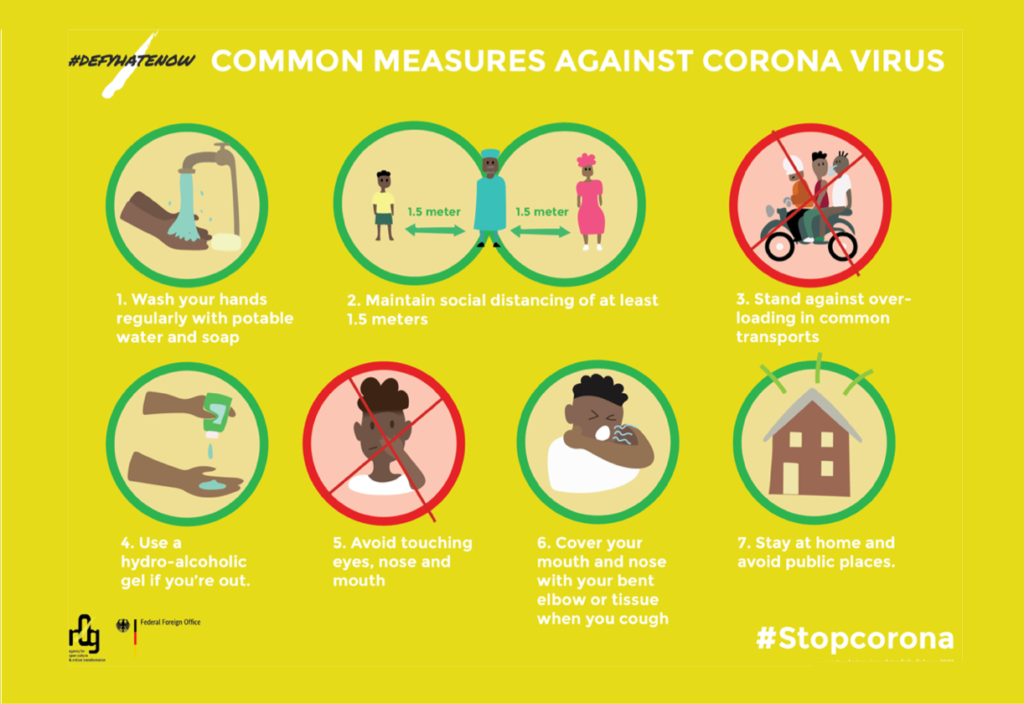
No handshaking or kissing on the cheeks
Even if it seems rude at first, refrain from shaking hands with each other. Avoid physical contact in general.
Clean your hands frequently
Clean your hands with an alcohol-based hand rub or wash your hands thoroughly with soap and water, especially before preparing food, before eating, or when you get home. Always wash your hands after using the toilet or if the hands are visibly dirty.
Keep your hands away from your face
Pathogens can easily pass from the hands to the mucous membranes of the eyes, nose, and mouth. Avoid touching your face.
Hygienic coughing and sneezing
When coughing, “hand over mouth” is well-intended, but in doing so you catapult a large number of viruses out of your body, which then sticks to your hands. So do not cough into your hands, but rather into your sleeve or a tissue.
Discard used tissues immediately
Throw used tissues immediately into the trash – preferably into a container with a garbage bag that you can close tightly and dispose of regularly. Then please wash your hand.
Ventilate regularly
In closed rooms, the number of viruses in the air can increase dramatically.
Regularly ventilating a room (three to four times a day for ten minutes) counteracts this and thereby reduces the risk of infection.
It also improves the indoor climate and prevents the mucous membranes of the mouth and nose from drying out.
Keep your distance and avoid crowds
Keep the greatest possible distance from other people when coughing, at least 1 meter, to avoid breathing in droplets, which could include the novel coronavirus causing COVID-19, if the person is infected.
Pay attention to the first symptoms
If you have a fever, cough, or difficulty breathing, see a doctor as soon as possible. Important: call beforehand so that you are directed straight to the right health facility and thus avoiding to get in touch with too many people. Follow the directions of your local health authority.
Do not share objects
Avoid sharing objects and touching surfaces in public spaces as it is known that the novel coronavirus that causes COVID-19 remains on surfaces4). If you think an object may be infected, contaminated, clean it using a surface disinfectant followed by washing your hands.
When to use a face mask
The WHO recommends wearing a mask only when you are taking care of a person with suspected COVID-19 infection or when you are coughing or sneezing yourself. In this case, the mask is to protect people around you. If you wear a mask, you should know how to use it. The video below explains when the use of a face mask is recommended and how it should be used.
Comments
Post a Comment